

The Role of Dynamic Ad Agencies in Modern Marketing Success
Marketing used to be pretty linear: write the message, buy the media, measure the results, repeat. Now it’s more like juggling while riding a bike… in traffic… while the rules of the road keep changing.
That’s why dynamic ad agencies (the kind that move fast, test constantly, and blend creative + data + tech) are becoming the secret weapon behind modern marketing performance. They don’t just “run ads.” They build adaptive systems that keep learning—across channels, audiences, and creative variations—while staying compliant in a privacy-first world.
This post breaks down what “dynamic” really means today, what capabilities matter most, how AI fits in (without hype), and what to look for when choosing an agency partner.
What is a “dynamic ad agency,” really?
A dynamic ad agency is one that can continuously adapt creative and media based on performance signals, audience context, and business goals—without waiting for a quarterly recap to make changes.
This is tightly connected to Dynamic Creative Optimization (DCO): the practice of tailoring ad elements (images, copy, CTAs, product selection, etc.) in near real-time using data and automation. Multiple ad platforms and ad tech providers define DCO as assembling/optimizing creative based on signals like audience, location, and context. For example, Google’s dynamic creatives “swap out” elements like images, CTA text, and exit URLs using feeds and rules. (Google Display & Video 360 dynamic creatives) Another example definition describes DCO as personalized ads using real-time data. (Amazon Ads guide to DCO)
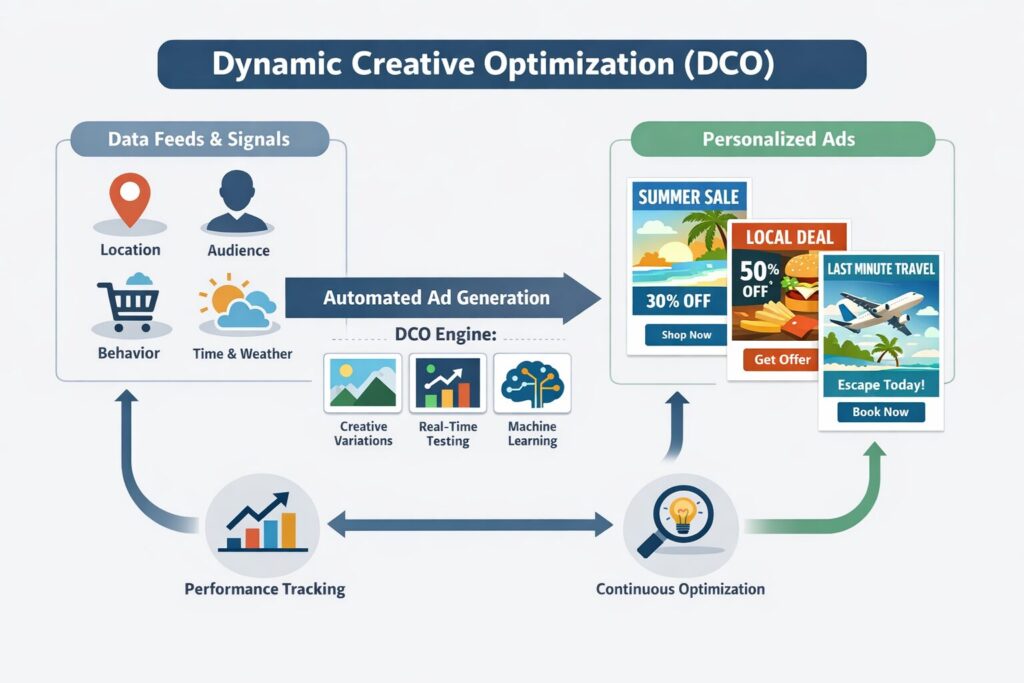
In plain English: dynamic agencies ship more versions, learn faster, and improve performance steadily—without breaking brand consistency.
Why “dynamic” matters more than ever
1) Creative is now modular (and platforms reward it)
Modern ad formats often test combinations of assets automatically. For example, Responsive Search Ads in Google Ads allow advertisers to provide multiple headlines/descriptions, and Google tests combinations and learns which perform best. (Google Ads Help: responsive search ads)
That means agencies can’t think in one-off “final” ads anymore. They need a creative system: interchangeable headlines, value props, imagery, CTAs, and proof points—built for testing.
2) Measurement is changing because privacy is changing
Between consent requirements and evolving cookie approaches, measurement increasingly relies on privacy-safe methods and modeling.
Google’s Consent Mode is one example: it adjusts tag behavior based on consent choices and uses “pings” to help enable measurement and conversion modeling in a privacy-conscious way. (Consent mode overview, Google Ads Help: consent mode) Google also documents conversion modeling as a way to help fill measurement gaps when journeys aren’t observable. (Google Ads Help: consent mode modeling)
Dynamic agencies need to be fluent in this reality—because “perfect attribution” is not coming back.
3) AI is now part of the ad stack (whether you asked for it or not)
Many platforms use machine learning to optimize targeting, bidding, and creative assembly. Your agency’s job isn’t to slap “AI-powered” on a slide. It’s to design the inputs, guardrails, and feedback loops so the platform learns the right thing.
The core capabilities of a truly dynamic ad agency
Here’s what you actually want the agency to be good at—beyond “we run Meta and Google.”
1) Strategy that translates into testable hypotheses
A dynamic agency doesn’t just hand you “a campaign concept.” They build a testing roadmap:
- Clear audience assumptions (who/why/what they care about)
- Offer strategy (what’s the hook and what’s the proof?)
- Messaging angles (pain points, outcomes, differentiators)
- A test plan (what changes, what stays constant, what “wins”)
If there’s no hypothesis, you’re just spinning the roulette wheel faster.
2) Creative systems built for speed (Creative Ops)
Dynamic agencies invest heavily in creative operations, because iteration velocity is a competitive advantage.
That usually includes:
- Modular ad templates (static, video, display, social)
- A naming and versioning system (so you can analyze what worked)
- Production workflows that don’t bottleneck on approvals
- Brand guardrails baked into templates
This matters even more if you’re doing DCO-style variations where you might swap:
- product image
- price/promo text
- CTA
- location copy
- benefit statement
(Google: dynamic creatives elements you can swap)
3) Platform-native creative testing (not “set it and forget it”)
Dynamic agencies understand how each platform learns and what it needs:
- Google Ads asset combinations (e.g., RSA learning) (Google RSA documentation)
- Feed-based creative where product data drives visuals/copy
- Video creative variants tailored for placement (YouTube, Reels, TikTok, etc.)
They don’t just launch. They monitor, prune, and refresh to avoid creative fatigue and to keep learning stable.
4) AI used responsibly (and practically)
AI inside dynamic agencies usually shows up in two places:
A) Generative AI for creative iteration
- first-draft variations of headlines/hooks
- clustering customer reviews into message themes
- generating multiple CTA options
- rapid storyboards or concept directions (human-reviewed)
B) Predictive/optimization AI
- budget pacing
- bid strategies
- creative rotation insights
- conversion modeling / measurement support (platform-dependent)
The important part: agencies should follow governance practices so AI use doesn’t create brand, legal, or reputational risk.
A credible reference point here is the NIST AI Risk Management Framework (AI RMF 1.0), which focuses on managing AI risks and improving trustworthiness (validity, safety, transparency, accountability, etc.). (NIST AI RMF overview, AI RMF 1.0 PDF)
If an agency says “we use AI,” a good follow-up is:
“Cool—what’s your review process and risk framework?”
5) Measurement that works in a consent-first world
Dynamic agencies need to be strong in:
- conversion tracking foundations (pixels/tags/events)
- consent-aware tracking setups (where relevant)
- modeled measurement realities
- incrementality thinking (testing what ads actually cause)
Google’s Consent Mode documentation is a useful example of how platforms adapt measurement based on consent. (Consent mode docs, Google Ads consent mode help)
Also, if you advertise in regions impacted by GDPR-style consent needs, agencies should understand industry consent frameworks like the Transparency & Consent Framework (TCF). (IAB Europe TCF)
6) Technical fluency across the marketing stack
Dynamic agencies don’t need to build your whole data warehouse, but they should speak fluent “modern marketing plumbing”:
- analytics + event taxonomy
- tag management
- feed management (products, locations, services)
- CRM/audience syncing (where applicable)
- landing page testing (speed, relevance, conversion)
They should also be comfortable with platform changes. For example, Google’s Ads Creative Studio was sunset as of March 2025—meaning agencies need alternative partner workflows for scaled customization. (Ads Creative Studio notice)
7) Content + SEO awareness (because ads don’t live in a vacuum)
Yes, this is an ads post—but dynamic agencies increasingly win by connecting paid learnings back into content and site experience.
And if you care about performance and discoverability (including AI-driven discovery), agencies should understand:
- people-first content principles (Google: helpful, reliable, people-first content)
- structured data basics (Google: structured data intro, structured data guidelines)
That’s not “nice to have.” It’s how you make ad spend more efficient over time.
What “good” looks like: a dynamic agency workflow (example)
A healthy dynamic agency loop often looks like this:
- Research + positioning
- Messaging map (claims + proof + objections)
- Creative modules (hooks, benefits, CTAs, offers)
- Launch with clean measurement
- Weekly optimization rhythm
- keep winners
- cut losers
- add new variants based on learnings
- Monthly insight report
- not just KPIs—what you learned about customers
- Quarterly strategic refresh
- new angles, new segments, new creative directions
Images you can add to illustrate the post
You can embed these as images in your CMS (with proper attribution/usage rights). Each one supports a key section of the article:
- Diagram-style visual explaining DCO
Source: RevX article page (includes DCO illustration). - Cookie consent / privacy illustration
Source: Enzuzo blog page (cookie consent visual). - Cookie consent solutions / process layout
Source: Bounteous (process graphic on-page).
Generative engine optimization (GEO) notes for this article
If you want this post to perform well in AI-driven discovery (and traditional search), here are the on-page elements that help—without gimmicks:
- Clear definitions early (dynamic agencies, DCO, consent mode)
- Scannable structure (short sections, bullets, checklists)
- Specific references to authoritative docs (Google Search Central, Google Ads Help, NIST)
- Practical “what to look for” lists (buyers love these; so do summarizers)
- FAQ section (AI systems often pull from Q&A-style blocks)
Google’s guidance on helpful, people-first content and structured data is a solid baseline for making content understandable to both users and machines. (People-first content guidance, Structured data intro)
Quick checklist: hiring a dynamic ad agency
Use this when you’re interviewing agencies:
- Do they have a test plan (not just a media plan)?
- Can they show a creative system (modules, templates, versioning)?
- Do they understand platform learning (RSAs, dynamic creatives, etc.)?
- Do they talk about measurement under consent without hand-waving?
- Do they have a clear policy for AI usage + human review (ideally aligned to a risk framework like NIST AI RMF)?
- Can they explain what they’ll do in the first 30/60/90 days?
FAQ
Are dynamic ad agencies only for big brands?
No. Smaller teams often benefit more because the agency acts like an extension of your team—especially for creative velocity and testing discipline.
Is DCO only for ecommerce?
Not anymore. Feeds can be products, yes—but they can also be locations, services, offers, or content modules. The concept is the same: modular creative + rules/data = more relevant ads. (Google dynamic creatives overview)
Won’t AI just replace agencies?
AI is already inside many ad platforms. What brands still need is the strategic layer: deciding inputs, guardrails, brand voice, compliance, measurement sanity checks, and creative direction. That’s where strong agencies earn their keep.
Final thought
Modern marketing success comes from momentum: shipping, learning, refining, and repeating—fast. Dynamic ad agencies win because they treat advertising as a living system, not a set of one-time deliverables.
If you want a partner who can keep up with platform automation, privacy constraints, and AI-assisted iteration—while still making creative that feels human—dynamic is the direction.


Leave a Reply